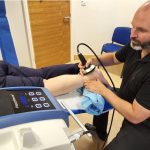
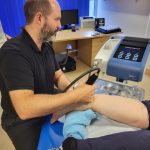
At Regen Chiropractic & Shockwave Therapy Clinic in Milton Keynes, we offer Focused Shockwave Therapy or Focused Extracorporeal Shockwave Therapy (f-ESWT). Focused Shockwave Therapy is great for treating ongoing stubborn injuries of the tendons, muscle, ligaments and joints including problems that have not responded well to other types of treatment.
It is also a great non-invasive treatment option for patients wanting to avoid having steroid injections or surgery. It is also used by many professional sports teams due to its effectiveness and ability to speed recover from difficult to treat injuries.
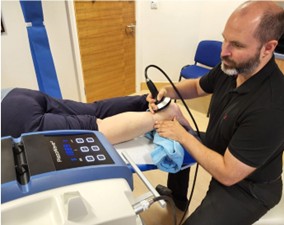
What Can Focused Shockwave Therapy Treat?
Shoulder pain
Rotator Cuff Tendonitis/tendinopathy
How Can Focused Shockwave Help Rotator Cuff Tendinopathy/Tendonitis?
What is Rotator Cuff Tendinopathy?
The rotator cuff is a group of muscles that help stabilise the shoulder joint and control its movement. Rotator cuff tendinopathy is a common source of shoulder pain, characterized by degeneration, micro-tears, and inflammation of the tendons (often the supraspinatus) in the shoulder, causing pain and weakness. It is also often referred to as rotator cuff tendonitis, subacromial impingement syndrome or shoulder impingement. Bursitis is also often present at the same time
Common symptoms include:
• Pain lifting and or twisting the arm e.g. getting dressed or overhead work
• Pain in bed especially lying on affected side
• Feeling of weakness in the arm when lifting
• Pain during and after activity e.g. gym exercise, swimming.
Causes include:
• Repeated overuse e.g. manual work
• Poor technique e.g. poor lifting technique in gym,
• More common in older adults


Elbow Pain
Tennis Elbow
How Can Focused Shockwave Help Lateral Epicondylitis or Tennis Elbow?
What is lateral Epicondylitis or Tennis Elbow?
Lateral epicondylitis or tennis elbow is the chronic painful condition caused by overuse and repetitive resulting in pain on the outside of the elbow
Common symptoms include:
• Pain on the outside of the elbow over the bone where the tendons attach
• Pain is worse when gripping and twisting movements
• Pain can spread into the forearm
Causes include:
• Repeated overuse and repetitive gripping e.g. manual work, painting, computer use,
• Sports involving gripping-racket sports, weight lifting, golf
Golfers Elbow
How Can Focused Shockwave Help Medial Epicondylitis or Golfers Elbow?
What is Medial Epicondylitis?
Medial Epicondylitis or Golfers elbow is the chronic painful condition caused by overuse and repetitive resulting in pain on the inside of the elbow.
Common symptoms include:
• Pain on the inside of the elbow over the bone where the tendons attach
• Pain is worse when gripping and wrist bending/twisting movements
• Pain can spread into the forearm
Causes include:
• Repeated overuse and repetitive gripping e.g. manual work, painting, computer use,
• Sports involving gripping/wrist bending-racket sports, weight lifting, golf


Hip pain
Gluteal tendonitis, Greater Trochanteric Pain Syndrome (GTPS)
How Can Focused Shockwave Help Gluteal Tendinopathy/GTPS?
What is Gluteal tendinopathy/GTPS?
Gluteal tendinopathy is a common, often chronic, injury of the tendons connecting the gluteal muscles (buttocks) to the hip bone, resulting in pain on the outer side of the hip. It is primarily an "overload" condition causing tissue degeneration rather than simple inflammation. It is often also called Greater Trochanteric Pain Syndrome (GPTS), trochanteric bursitis, gluteal tendonitis or hip tendinopathy
Common symptoms include:
• Pain and tenderness on the outside of the hip
• Pain sleeping in affected side
• Pain on walking, going up stairs and sitting with legs crossed
Causes include:
• Overuse involving hip motion e.g. running
• Increasing activity levels to quickly e.g. increasing distance or training load
• Weak hip muscles
• Biomechanical factors e.g. coexisting foot, knee or hip issues
• Poor conditioning e.g. more common in overweight individuals
• Hormonal factors - more common in women age 40-60 years
Benefits
Non-surgical and non-invasive, avoiding injection or more invasive treatments.
May help patients avoid surgery.
Often considered after other conservative treatments have been unsuccessful.

Knee Pain
Patellar Tendinopathy/Tendonitis
How Can Focused Shockwave Help Patella Tendinopathy/Tendinitis?
What is Patella Tendinopathy/Tendinitis?
Patella tendinopathy is a painful condition which causes pain where the quadriceps tendon attaches at the bottom of the kneecap (patella). It is also often referred to as jumpers knee and is caused by overuse.
Common symptoms include:
• Localised pain and tenderness at the bottom of kneecap
• Knee stiffness especially in the morning
• Pain with running and jumping activities
Causes include:
• Overuse injury
• Increase training load to quickly
• Increased body weight
• Tight and/or weak quads
• Poor footwear choices
• Training on hard surfaces

Heel pain
Achilles Tendonitis/Tendinopathy
How can Focused Shockwave Help Achilles Tendinopathy (Achilles tendonitis)?
What is the Achilles tendon?
The Achilles tendon is one of the largest and strongest tendons in the body. It attaches the muscles that point your foot downwards (soleus and gastrocnemius) to the back of your heel bone (calcaneus). Your Achilles tendon is important in the function of the foot. It propels you forward when you walk and run.
What is Achilles tendinopathy?
Achilles tendinopathy also called Achilles tendonitis is a common condition that happens when the Achilles tendon becomes painful. This can happen for many different reasons. The main reasons are tendon degeneration and tendon overload.
Common symptoms include:
• Pain felt in the tendon
• Stiffness when moving after periods of being inactive
• Point tenderness in the tendon or where it attaches to the heel bone.
• Swelling of the tendon
Causes of Achilles tendinopathy
•Tight muscles around the ankle and/or stiff joints around the ankle
• Certain foot postures make it more common – either high arched or low arched
• Sudden changes or increases in activity levels or exercise
• Poor footwear
• Weakness in the muscles that point the foot downwards
• Health related issues such as obesity, high blood pressure (hypertension), hyperlipidaemia, diabetes and sero-negative arthropathies
• More common in middle-aged people
• More common in men
Insertional Achilles Tendinopathy (Achilles tendonitis)
How can Focused Shockwave Help Insertional Achilles Tendinopathy (Achilles tendonitis)?
What is Achilles Heel pain?
Achilles heel pain involves pain and swelling where the strong tendon from the calf muscles attaches to the heel.
What are the symptoms?
• Pain and swelling in the heel bone where the Achilles tendon attaches
• The pain is usually worse when wearing footwear, first thing in a morning or when taking your first steps after a period of rest
• Walking can improve pain to start with but can then worse over time and afterwards
Causes of Achilles tendinopathy
• Tight muscles around the ankle and/or stiff joints around the ankle· Certain foot postures make it more common – either high arched or low arched
• Sudden changes or increases in activity levels or exercise
• Poor footwear causing compression and irritation to the tendon
• Haglund’s Deformity- A bony spur on the heal that rubs against the tendon
• Health related issues such as obesity, diabetes, older population and Sero-negative arthropathies


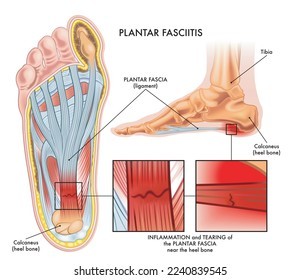
Plantar Fasciitis
What is Plantar Fasciitis?
The Plantar fascia is a band of collagen tissue that connects between your heel and your toes, supporting the arch of your foot. Just like a joint, the Plantar Fascia is also subject to becoming irritated, this is known as Plantar Fasciitis. Focused shockwave therapy (FSWT), also known as Extracorporeal Shockwave Therapy (ESWT), is a non-invasive treatment option for chronic plantar fasciitis.
What are the Symptoms of Plantar Fasciitis?
• People usually complain of pain under the heel which is worst 1st thing in the morning and after rest. This is because when our feet are at rest the plantar fascia contracts and shortens, when we move the plantar fascia is suddenly stretched causing pain.
• Pain is present when weight-bearing such as walking, standing or running. This is because when our feet are at rest the plantar fascia contracts and shortens, when we move the plantar fascia is suddenly stretched causing pain.
• Symptoms usually start gradually but can be caused after a sudden stretch and sometimes for no known reason.
Risk factors include:
• Poor ankle/foot mechanics e.g. flat footedness
• Change in footwear
• Poor conditioning e.g. obesity, weakness and/or tightness of the leg muscles
• Overuse injury, such as repetitive uphill running
• Sudden increase in training

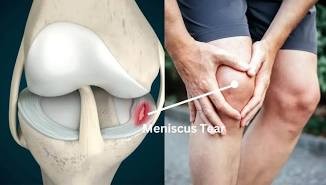
Meniscus Tears
Meniscus Tears
A meniscus tear is a common knee injury involving damage to the shock-absorbing cartilage, typically causing pain, swelling, and a locking sensation in the joint.
Common Symptoms
• Pain: Sharp ache along the joint line, worsening when twisting or putting weight on the leg.
• Swelling: Stiffness and fluid build-up developing over 24 to 48 hours.
• Mechanical issues: A popping sound during injury, or the knee catching, locking, or giving way.
Causes and Risk Factors
• Twisting injuries: Sudden forceful rotation of the knee while the foot is planted, common in sports like football or basketball.
• Degeneration or ‘wear and tear’: Gradual weakening of the cartilage from aging over age 40, triggered by minor awkward movements.
How Can Focused Shockwave help?
Focused shockwave stimulates blood flow and new blood vessel formation which can speed healing of meniscus injuries.
Shin splints
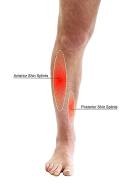
Shin Splints
Shin splints are pain and tenderness along the shin bone caused by exercise overuse. They commonly affect runners and dancers when activity levels increase too fast.
Symptoms
• Dull ache or sharp pain along the front or inner lower leg
• Soreness when touching the shin area
• Pain that starts during exercise and eases with rest
Causes
• Sudden increases in running distance, intensity, or frequency
• Exercising on hard or uneven surfaces
• Worn-out or unsupportive shoes
• Flat feet or high arches
Ligament injuries
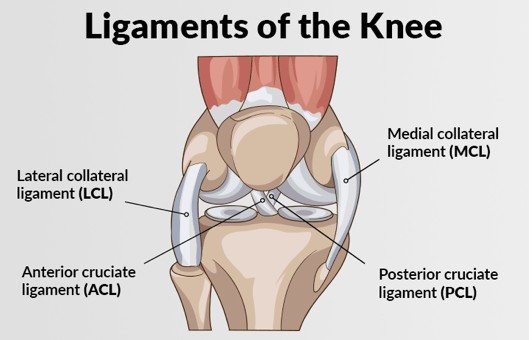
What is a ligament injury?
Ligaments connect bone to bone to help stabilise the joints. A ligament injury or sprain occurs when the ligaments which are tough bands of tissue connecting your bones are stretched or torn by a sudden twist, fall, or impact.
They are grouped into three grades of severity: mild stretching grade 1, partial tearing i.e. grades 2, and complete rupture grade 3.
How Can Focused Shockwave Help?
Focused Shockwave therapy helps reduce pain and speed up tissue healing for ligament injuries.
Osteoarthritis
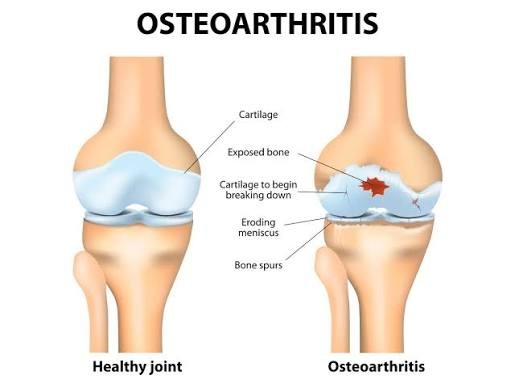
Osteoarthritis
Osteoarthritis is a common joint disease characterized by cartilage breakdown, bone changes, and joint pain. It happens when the slippery tissue cushioning the ends of bones wears away over time.
Symptoms
• Pain in the joint during or after use
• Stiffness after resting or waking up, lasting under 30 minutes
• Swelling or a grating/crackling sound when moving
Risk Factors
• Older age as joints experience long-term wear
• Obesity, which puts extra physical stress on weight-bearing joints like knees and hips
• Joint injuries or past trauma from sports or accidents can speed up the process
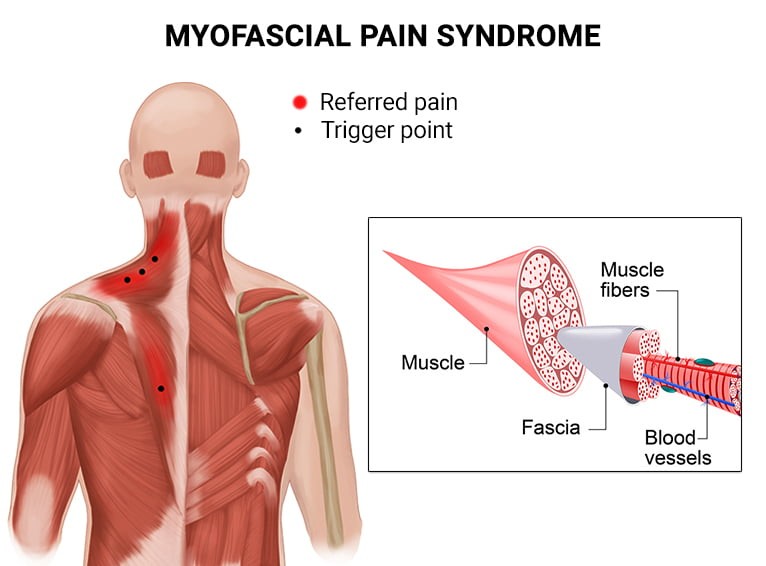
Myofascial Pain Syndrome
What is myofascial pain syndrome?
Myofascial pain syndrome (MPS) is a chronic musculoskeletal pain disorder characterized by inflammation and localized pain in the muscles and their surrounding connective tissue, known as fascia. Unlike everyday muscle soreness, this condition is driven by myofascial trigger points, which are highly sensitive, pea-sized knots of tight muscle fibres that fail to relax.
Symptoms
• Deep, aching pain: The pain feels like a constant throbbing, tightness, or vice-like grip within a specific muscle group.
• Referred pain: Pressing on a trigger point frequently triggers pain in a completely different area of the body.
• Taut, touch-sensitive knots: Hard nodules or "rope-like" bands can be physically felt under the skin.
Causes & Risk Factors
• Muscle overuse: Repetitive strain from tasks like computer typing, lifting heavy items, or intense physical training.
• Poor posture: Slouching or holding unnatural positions for extended periods.
• Acute injury: Direct trauma or strain to a muscle group can leave behind lingering trigger points.
• Stress and anxiety: Mental tension often manifests physically, causing people to continuously clench and tighten their muscles.
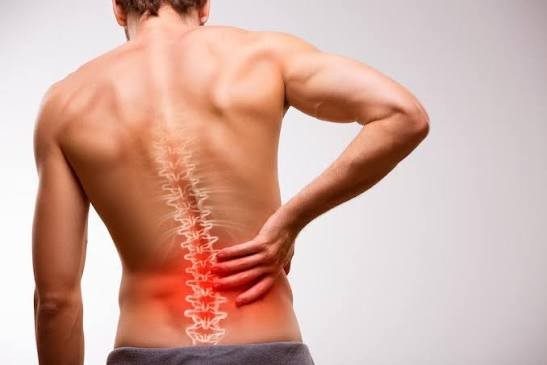
Chronic back pain
What is Chronic Back Pain?
Chronic back pain is defined as discomfort, stiffness, or aching in the back that persists for 12 weeks (3 months) or longer. Unlike acute back pain, which acts as a temporary warning signal and resolves as an injury heals, chronic pain lingers long after the initial tissue damage has subsided or develops gradually over time due to progressive underlying conditions. It affects approximately 20% to 30% of adults globally.
Common Symptoms
• Persistent Aching: A continuous, dull ache localized in the lower, middle, or upper spine.
• Sharp, Shooting Pain: Sudden stabbing sensations, particularly during specific movements like bending, lifting, or twisting.
• Physical Limitations: Severe muscle spasms, structural stiffness, and difficulty standing up straight for extended periods.
• Secondary Effects: General fatigue caused by disrupted sleep patterns, alongside emotional strains like anxiety, depression, and frustration.
Causes & Risk Factors
• Degenerative Changes: Conditions like osteoarthritis break down the protective cartilage cushioning the spinal joints. Degenerative disc disease or bulging/ruptured discs can also place direct pressure on adjacent spinal nerves.
• Structural Issues: Spinal stenosis (the narrowing of the spinal canal) or spinal curvatures like scoliosis put mechanical stress on the spine.
• Muscle Imbalances: Prolonged poor posture, physical deconditioning, or core muscle weakness force certain back muscles to overtighten to keep the body upright, creating a continuous cycle of strain.
• Lifestyle Factors: Excess body weight places higher mechanical loads on spinal discs, while smoking restricts blood flow and slows down structural healing in the spine
Focused Shockwave Therapy is an advanced form of Shockwave Therapy. It is a highly effective, non-surgical, non-invasive treatment which uses high energy sound waves to help stimulate tissue healing, reduce pain, increase blood flow and stimulate the body's own healing processes.
It has been proven to be especially helpful for chronic long term tendon injuries, that have not responded to other treatments, including Plantar Fasciitis, Shin Splints, Tennis Elbow, Greater Trochanteric Pain Syndrome (hip tendon pain) and Calcific Shoulder Tendinopathy.
Focused Shockwave Therapy is included in the NICE guidelines used by the NHS for these conditions.
It has also been shown to be beneficial for many other chronic pain conditions that responded poorly to other treatments.
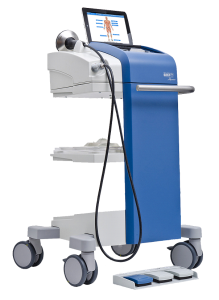
How does Focused Shockwave Therapy work?
Focused Shockwave works by using focused high energy soundwaves to:
• Reduce pain
• Promote tissue regeneration and healing
• Improve blood flow and stimulate new blood vessel growth
• Induce calcific reabsorption in tendinopathies
• Reduce muscle myofascial trigger points (muscle knots)
How many Shockwave Therapy sessions will I need?
Some patients report significant improvement after 1 session but a minimum of 3 sessions is required in most cases for long term benefit due to the complicated nature of the injuries it's used to treat. Most patients require 3-6 sessions depending on the type of injury, level of injury and individual patient characteristics.
Why Focused Shockwave therapy may be right for you?
• Treats stubborn, chronic long-term injuries that have not responded to other treatments
• 60-90% success rate for chronic injuries
• Very safe with minimal side effects
• Non-surgical and non-invasive
• Quick results

Why Choose Regen Chiropractic for your Focused Shockwave Therapy treatment?
At Regen Chiropractic & Shockwave Therapy Clinic, we use the most powerful Focused shockwave system on the market. This makes treatment more effective as more energy can be directed to the injury site so less treatments are often required.
Many other clinics use Radial Shockwave which although effective for superficial injuries can struggle to penetrate to deeper structures and larger joints such as the hip and shoulder tendons. Treatment with Focused Shockwave Therapy is often more comfortable and better tolerated by the patient, compared to Radial shockwave, as Focused shockwaves bypass the skin and superficial tissues to deliver energy directly to a specific point deep within the body (up to 12cm). Radial shockwaves disperse energy widely across the skin's surface, which can cause "skin drumming," irritation, and a more uncomfortable "thumping" sensation.
Steve has also had personal experience of Focused Shockwave Therapy as a patient himself, after suffering a tendon injury in his shoulder 5 years ago. After undergoing several other treatments including radial shockwave, steroid injections and PRP injections, which didn’t work, Focused shockwave therapy resolved the problem and it has not returned. This encouraged Steve to invest in Focused Shockwave to help others with stubborn injuries.
Frequently Asked Questions About Focused Shockwave Therapy
How long does each session last?
The first Shockwave Therapy appointment lasts 60 minutes. Each follow up Shockwave Therapy session lasts 30 minutes. 60 minute sessions can also be offered with multiple areas need treatment.
How much does it cost?
Shockwave therapy appointment costs £75, an extra £25 per session on top of the normal treatment fee. It is more expensive than other treatments but it is often more effective and pain resolves more quickly which will save you money in the long term.
How many sessions are needed?
Generally, we recommend 3 - 6 treatment sessions. As this is encouraging the body to heal itself your body will progress in the healing process even 2-3 months after treatment has stopped.
What Will Happen at Your Appointment?
- Consultation: Your Chiropractor will assess your condition through examination and review your medical history. Ultrasound or MRI scans may also be recommended to pinpoint the location of the injury.
- Treatment Sessions: A device delivers controlled focused shockwaves to the affected area along with exercises to help strengthen the tendon.
- Duration: Typically, 3-6 sessions approx. 5-7 days apart
- Recovery: Most patients can resume daily activities with minimal downtime. It is advisable to avoid high-impact activities or strenuous exercise for 48 hours after each treatment.
How can Focused Shockwave therapy Help?
Focused shockwave therapy (FSWT), also known as Extracorporeal Shockwave Therapy (ESWT), is a non-invasive treatment option for tendinopathy. FSWT uses high-energy sound waves directed at the affected area to stimulate the body's natural healing process. This can lead to:
- Increased blood flow and nutrient delivery to the inflamed tissue.
- New blood vessel formation.
- Cell regeneration and collagen production.
- Breakdown of calcifications.
- Reduced pain and inflammation.
Will I need any Ultrasound or MRI scans?
It is often beneficial to have an ultrasound or MRI scan before treatment if you have not had one before but it is not always necessary and is on a case-to-case basis. If one is required it can be arranged on site.
Is Focused Shockwave painful?
You may experience some discomfort during treatment but the pain should be tolerable. We always aim to keep the pain levels to a minimum while still having a positive treatment outcome.
Many patients report immediate pain relief following treatment due to the analgesic effect of Shockwave Therapy. If you experience pain after treatment, you may use ordinary non-prescription painkillers such as paracetamol. Do not use anti-inflammatory medication or Ibuprofen as both may interfere with the body's self-healing process.
Are There Any Potential Side Effects
- Mild discomfort, tingling sensation, or throbbing pain during and immediately after the treatment.
- Temporary skin reddening, bruising, or swelling.
What the difference between Focused and Radial Shockwave?
Focused Shockwave Therapy allows us to pinpoint damaged tissue, target this region and treat effectively with no impact on healthy tissue. Radial shockwave was an off-shoot of focused shockwave in the 80s and 90s as it was a cheaper system to make and sell. The evidence is good for radial shockwave, but the strongest and best evidence is for focused shockwave.

Focused Shockwaves generates the energy outside the body and is then delivered to a focal target area deep inside the body. Radial Shockwaves are actually pressure waves and differ considerably from focused shockwaves. The energy spreads out on contact with tissues and the density of energy dissipates rapidly through the top layers of the skin reducing penetration depth. This makes Radial systems unsuitable for targeted deeper areas.
Focused Shockwave treatment on the other hand is more accurate targeting a specific area, more powerful and more comfortable for the patient. Focused Shockwave Therapy is much better suited for treating deeper structures that can't be reached using Radial Shockwave.
Is Focused Shockwave Therapy safe?
Yes. It has NICE guidance for a large number of indications and is used within the NHS.
How long before I feel an improvement?
After only 1 to 2 sessions at Regen, many of our patients report complete pain relief or significant pain reduction. The therapy eliminates pain or restores full mobility, thus improving your quality of life. However, this improvement depends on the severity, chronicity and type of injury.
How successful is Shockwave therapy?
Statistics vary based on the condition being treated - varying from 60-90% success rate. For example, studies have shown 90% of patients with Achilles Tendonitis (Heel pain) will experience a full recovery or significant reduction in their pain and injury.
Can Shockwave treat old/persistent injuries?
Shockwaves can treat both long-term chronic conditions and newer injuries. There is a great deal of evidence to show that Shockwave Therapy can achieve great results even with long-term stubborn injuries.
What are Shockwaves?
Shockwaves are high energy sound waves which are transmitted to the affected area to accelerate healing. The treatment increases blood flow, decreases localised pain and stimulates cell regeneration - this encourages the body to repair itself. Shockwaves also break down scar tissue and calcifications.
Does my private health insurance cover it?
Some private health insurance providers have cover for Shockwave Therapy - please ask your provider for more details. Please note there may be an excess to pay.
Is there any reason I will not be able to have Shockwave therapy?
Shockwave therapy is very safe and has few contraindications or side effects. However, it is not suitable for everyone. Some of the situations when Shockwave Therapy is not suitable are.
- Steroid injection into the area to be treated within the last 12 weeks
- Some blood thinning medications
- Haemophilia / Clotting disorder / Risk of haemorrhage
- Cardiac pacemaker or another cardiac device in the treatment area
- Tumour at site of treatment
- Infection at site of treatment

Price List for Focused Shockwave Therapy